Tag: dot-net
-

Exploring the Zip Method in LINQ: A Game-Changer for Merging Sequences
Have you come across the Zip method in LINQ? It’s an incredibly useful feature for merging sequences, and it’s a must-have for any developer’s toolkit. Let’s explore how this method can streamline your coding process, particularly with the new enhancements in .NET 6.
-
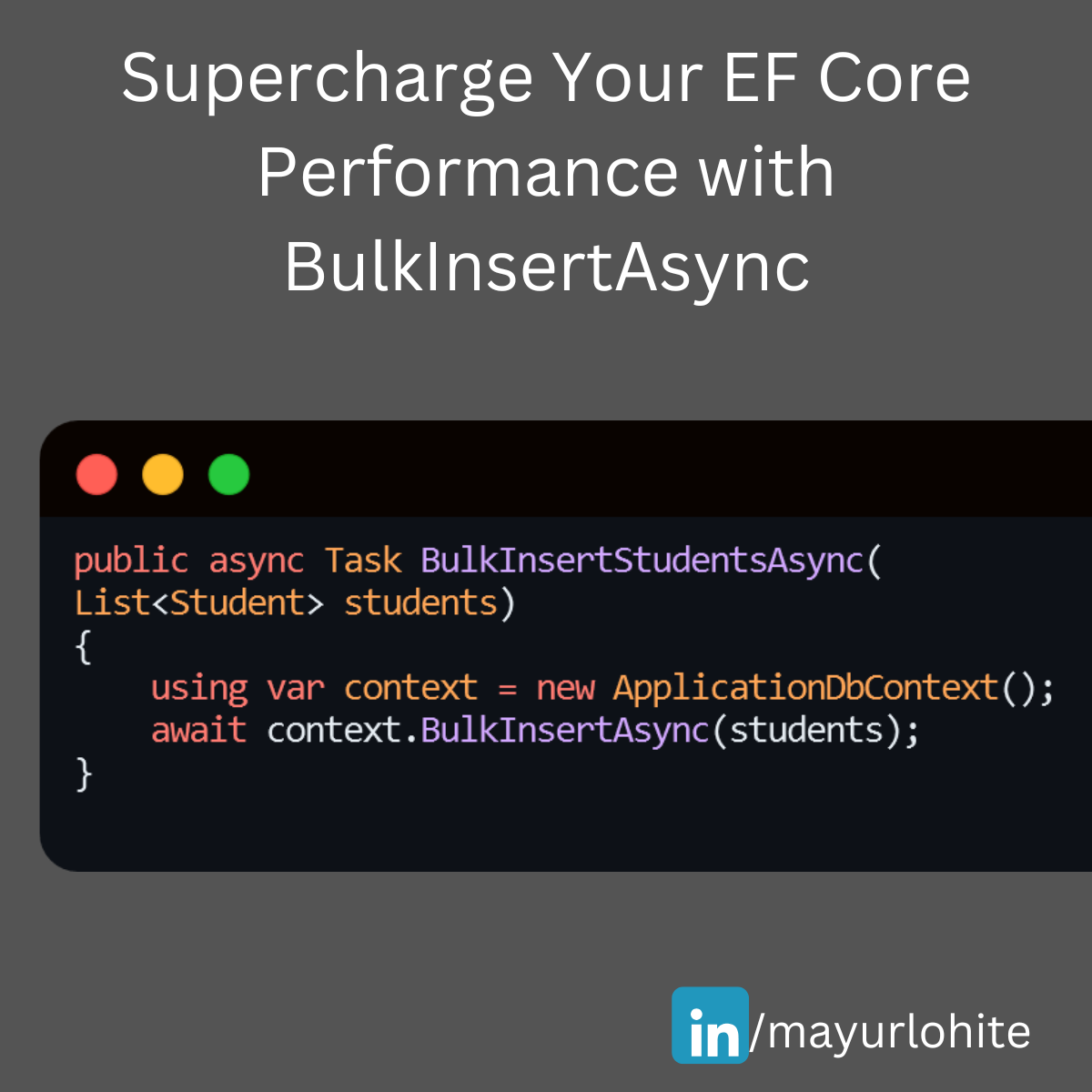
Supercharge Your EF Core Performance with BulkInsertAsync
Having issues with large data saving/insert in your .NET applications? EF Core’s BulkInsertAsync could be the solution you need. Simply install EFCore.BulkExtensions from NuGet. Here’s a quick guide to help you get started
-

Building a Basic open source E-Commerce Website with ASP.NET Core 8
In this blog, we’ll explore how to build a basic eCommerce website using ASP.NET Core 8. We will use MLCart, an open-source project available on GitHub, to demonstrate key features and how to get started with building your own eCommerce platform.
-

Performance optimization and monitoring in ASP.NET Core: Best Practices with Examples
In this comprehensive guide, we’ll delve into various techniques, best practices, and tools for optimizing performance and monitoring the health of ASP.NET Core applications, accompanied by detailed examples
-

Understanding LINQ and Lambda Expressions in C#
LINQ (Language-Integrated Query) and Lambda expressions are powerful features in C# that allow developers to query and manipulate data in a concise and expressive manner.
-

Understanding Interfaces and Abstract Classes
In this blog post, we’ll explore these foundational concepts, discussing their definitions, differences, benefits, and providing clear examples in C#.
-

Implementing Dynamic Pagination with Filters in ASP.NET Core
In this guide, we’ll explore how to implement dynamic pagination with filters in an ASP.NET Core application step by step.
-
How to check if string is null or empty? or it does not contains anything in C#
In every project developed within the .NET framework, whether it’s a web, console, Windows, or mobile application, it is crucial to validate whether a string is empty, null, or contains anything, including whitespace. Therefore, I’m sharing this C# tip to demonstrate the optimal approach for checking if a string is null, empty, or consists solely…